"Why do you go away? So that you can come back. So that you can see the place you came from with new eyes and extra colors. And the people there see you differently, too. Coming back to where you started is not the same as never leaving." ~Terry Pratchett
Tuesday, October 17, 2017

Wednesday, June 29, 2016
Reflecting on Year 3
 |
| 2016 Keystone Degree Recipients |
And just
like that, my 3rd year of teaching has come to a close! As they say, things certainly do get easier with time and this year of teaching was no exception. I couldn't wait for the day that I could repeat an activity or lesson that I had previously created. I couldn't wait to see my first group of Freshmen grow into leaders on the officer team. And, I certainly couldn't wait to know all the ins and outs of our school's procedures. My second year went smoothly and in August of 2015, I was sitting back thinking that year 3 would be even better. Come June 2016, I can now say "Yes, it was easier, and no, it was harder than before."
 |
| Farm Show Career Connection Video Presentation Group |
I don't want to remember year 3 as the "terrible 3" because there were certainly numerous high points of the year. Having the same students as previous years, having a nearly identical teaching schedule, and finally getting to teach an Ag Mechanics course were just a few of the things I was excited about. In addition, attending my 1st (of hopefully many) NAAE Conventions as a Teacher's Turn the Key recipient was a pretty sweet experience as well.
 |
| Attendees at the Delaware Valley University CDE Conference |

Rather than rehashing the year, I'll summarize what my major "findings" were for the year.
1. Make very explicit expectations and monthly requirements for your FFA officer team. Yes, it's great to have the Officer Team create their own contract and expectations, but you as the advisor know best which events the officers should have a presence at. Let the kids create a draft, then introduce your thoughts. This makes your life easier for...(see #2).
2. Hold your officers accountable for their duties on a monthly basis. If they fail to complete their duties for 3 months, it's time to consider other ways to serve the chapter.
3. Keep a clear line of communication with your administrators (sometimes all 7 of them). This mantra has been a huge help so they can "keep out the crazies" and not waste my teaching time with petty concerns. Kenny Chesney says it best, "God is great, (an adult beverage) is good, and people are crazy."
4. Put everything in writing (because no one will read it anyway, but at least you tried and it gives you something to hand them when they are confused or arguing with you).
5. Know the skill set of your volunteers. It could be the difference between you holding their hand through the entire task (which you could have done independently) or you successfully delegating the task to a capable volunteer.
 |
| Group photo at ACES Conference. A record 53 students attended! |
At the end of some days this year, it became difficult to remember the real reason I went into teaching--to get kids excited about agriculture. Don't get me wrong, some days the stars aligned and we pulled off a rockin' after-school agriculture program. But other weeks, I questioned, "What else could go wrong?" This year was much more of a roller coaster than anticipated, but I've learned a great bit about how to overcome all the negativity--and the answer is simply teach.
Whenever I'd receive a negative phone call or ranting email, I found my way of pushing out the negativity was focusing on teaching (that's my job, right?) For 42 minutes, no one could disturb me, I didn't have to answer emails, and I couldn't have a meeting. Pulling out my best teaching strategies to spice up a lesson or coming up with a new way to explain a topic on the fly was my therapy. Some days, I wish I had a solid hour to sit down and plan a perfect lesson, but that time is eaten away by a laundry list of non-teaching responsibilities. This year, savoring each 42-minute class and making it the best 42 minutes of the day was my therapy.
 |
| Group photo from annual Educational Spring Trip to New York and Massachusetts |
So, my goals for next year...
1. Don't read my emails until after school. Reading a negative email at 6:30 am in the morning really set the tone for the day and ate up so much of my time that I should have been using to plan my day
2. Don't leave school on Friday until the next week's lessons are planned. I usually spent my Sunday night (and drive to school on Monday morning) mentally planning the week's lessons. I never felt unprepared, but that was mental time I stole from my weekend, which should have been relaxing.
3. Set monthly expectations for each FFA Officer and check progress at each monthly officer meeting.
4. Improve on summarizing each lesson and implement more frequent formative assessment (utilizing Google Forms and/or CASE Online)
The year honestly flew by and great strides were made in all aspects of my agriculture program--including classroom instruction, FFA, and SAE implementation. With numerous victories in CDE contests, Proficiency Awards, scholarships, and increased enrollment, I am happy to reflect upon the year and look forward to seeing my first group of Freshman graduate next year in 2017!
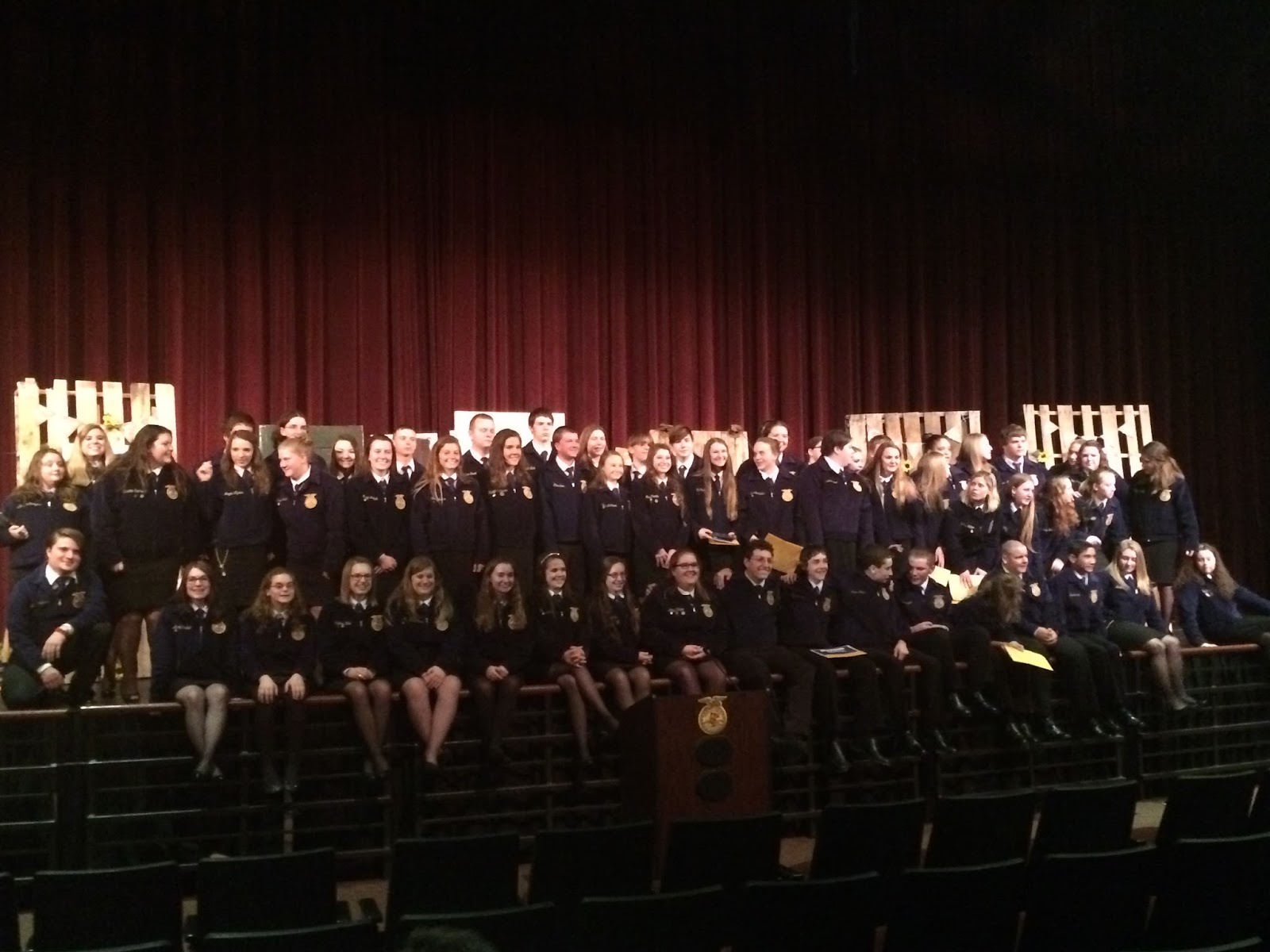 |
| 2016 Cumberland Valley FFA Banquet with 72 FFA members in attendance! |
Monday, March 30, 2015
Catch the Wave...Catch the Teach Ag Rave!
For the past few weeks, I've been assisting +/- 12 students in developing their own lesson for the 6th annual Penn State Teach Ag! Essay Contest. What is this, you may ask? A unique opportunity to say the least!
In this state-wide contest, the tables are turned as the students become the teachers. Students are given the chance to teach a class for a day to see the 'behind the scenes' of what it takes to conduct an Agriculture class. Students must identify a topic, create a lesson plan, receive teacher approval and feedback, teach the lesson, and construct a reflective essay about what they learned as a "teacher for a day."
Last year (2014), I had only 6 individuals participate in the contest, so I could 'micro manage' their every move to ensure they had a picture perfect lesson. With more students interested (and some of them repeating from last year), I had to learn to give up some control, give explicit directions about my expectations, and learn to trust my students and their abilities. With only 3 students left to teach at this point, I can say that these kids know their stuff and how to create a fun, engaging lesson!
Watching these students teach has reminded me during my student-teaching experience...wanting to have everything perfect, planning way too much content for a class period, and getting some blank stares from the crowd. Nonetheless, it was cool to see how each student (teacher) adapted to the challenges that were presented to them and how they overcame the ultimate challenge of teaching their peers. I frequently include 5-7 minute presentations into each of my classes, so students are used to speaking in front of their peers. But, keeping their peers' attention for 42 minutes was a new experience for most of them (and somewhat unique for me to sit back and analyze how each person responded).
I hope that the students enjoyed their teaching experience for a day and realize how much work goes into preparing a single lesson (let alone 6 different lessons each day). I hope that by promoting this event, it will benefit all parties involved by creating the opportunity for new conversations during class that may not have existed. Students may realize shared interests, see skills in a classmate that they never saw before, or have a new respect for 'how easy' teachers make teaching look.
Take a look at some of the awesome lessons that students developed!
 |
| Taylor E. (pink shirt) presented a lesson on various salamanders in Pennsylvania and even brought in some salamanders she caught herself on a scouting trip! |
 |
| Emiliann G. brought her 2-year-old gelding to school to give students in Introduction to Agriculture the chance to tack up a horse. |
 |
| Megan M., another animal lover, thought the best interest approach would be one of her chickens, Chicko! She discussed the benefits of purchasing farm fresh eggs. |
 |
| Courtney W. wanted to share her experience of butchering animals at a local farm. She discussed terminology for meat science, then gave her peers the chance to practice skinning a chicken wing--it's harder than you think! |
 |
| Mackenzie Y., a finalist in last year's Teach Ag! Contest wanted to discuss the precautions farmers take on their farms to improve biosecurity. She poured her own agar plates, then asked students to swab a dirty, clean, and disinfected boot to observe bacteria growth. Did cleaning or disinfecting kill more bacteria? |
Monday, February 2, 2015
CV FFA Members Shine at 2015 Pennsylvania Farm Show
Cumberland Valley FFA Members Shine at 2015 Pennsylvania Farm Show
Agriculture takes center stage each year at the Pennsylvania Farm Show, held in early January of each year. THis year, the PA Farm Show celebrated its 99th edition and Cumberland Valley FFA's involvement was evident in many departments within the exhibition.
Cumberland
Valley FFA has consistently participated in the Landscape Design contest, where chapters are asked to create a
design that is 10’ x 15’ in size. CV’s Plant Science & Landscape Design
class met the challenge and created an engaging landscape design. Students
enrolled in Plant Science also created several Horticulture Exhibits that were showcased the entire week.
Additionally,
FFA members experienced widespread success in the show ring with their market and breeding livestock projects.
With entries coming from across the Commonwealth, exhibitors bring the ‘best of
the best’ to compete for top honors.
To read the full update, please visit this link, Cumberland Valley FFA Newsletters, and click on "2015 Farm Show Update."
~D
 |
| 22 First-Year members received their FFA Jacket as part of the Pennsylvania FFA Alumni Jacket Campaign. Congratulations to all jacket recipients! |
 |
| Nick Crain, CV's 2015 Keystone Degree Recipient, poses with the 1st year jacket recipients at the Mid-Winter Convention. |
 |
| Several students entered Horticulture exhibits into the FFA divisions offered at the PA Farm Show. Abby Klinger's miniature landscape received "Best of Show" recognition! |
 |
| CV's Plant Science class designed, planned, and implemented a landscape in the annual competition. This year's theme was "Native Plants." The display placed 4th. |
 |
| Several students exhibited livestock in the Youth Market Divisions. 4 qualified for the Youth Sale of Champions by placing in the top 5 of their respective weight classes. Megan (in blue) and Paige (in plaid) show their market goats in Lightweight Division I. |
Sunday, October 26, 2014
Year 2---Go With the Flow!
As I look back to the first few weeks of my first year of teaching (last year), I wish I would have learned to "go with the flow" and enjoy things as they happened. I was much too worried about having my classroom being perfect, having all papers graded the minute they were turned in, coming in early to set-up all of my labs for the upcoming day, and having everything planned to a "T." I kept up with this idea of "perfection and planning" until about National Convention. After that point, I realized that I couldn't control every minute of every day and learned the art of flexible planning. Well, here I find myself the week of the 87th National FFA Convention looking back at the past 9 weeks and asking, "Where on earth did the 1st marking period go?" I looked back at my calendar and some of the photos taken over the past weeks and realized that all 3 components of our Agriculture Program have been exceptionally busy, but rewarding at the same time. Here's to recapping the past 9 weeks by the numbers.
Last, but certainly not least, is the ever-important 3rd component of any Agriculture Education program--SAEs! SAE is the extension of classroom learning that complements a student's interest and allows them to gain experience for their future careers. CV has a variety of SAEs ranging from various entrepreneurship projects where students raise livestock to home garden projects to off-farm employment and even agricultural communications. Part of the SAE process is for the Ag Teacher to provide supervision to the students conducting their SAEs. Over the past 9 weeks, I've visited about 13 students with various CDEs.
Some highlights include watching 2 students compete in a Central PA Rodeo Association show and learning that preparing a horse for rodeo events is a very strategic process, tagging 9 market animals for the Pennsylvania Farm Show, visiting a student that is shadowing a horse barn manager, helping 2 Freshmen get started on an Aquaculture SAE, and supervising 2 students begin their Poultry SAEs.
In addition, for 1 Senior and 8 Juniors, hard work and dedication to their SAE projects will pay off shortly as they are beginning to complete their applications for the Keystone and Area Degree, respectively. It is amazing to see all the growth these students have achieved in their SAE programs over the past 3-4 years!
I have numerous students I still need to visit, but our program is slowly beginning to put more of an emphasis on the importance of each student carrying an SAE.
As I'm preparing lesson plans for the upcoming week when we travel to Louisville for the 87th National FFA Convention, I'm looking forward to an exciting week! Our Ag Communications team has been practicing for the National Stage and our AgriScience Fair finalist is preparing to present her research on Equine Ethics. Time will sure fly by from now until Thanksgiving! Until then, go with the flow!
Classroom Instruction
This year I am teaching 6 courses (Introduction to Agriculture, Animal Science, Food Science, Growing our Agriculture Leaders, Independent Study (SAE), and Animal & Plant Biotechnology). Introduction to Ag has been exploring the history of food production and is currently finishing up a unit on communication and FFA history. Food Science has been conducting numerous experiments investigating how food ingredients affect the baking or cooking process while Animal Science has just begun to investigate the importance of biosecurity on farms. To say the least, these classes have been flying by and I'm actually getting to enjoy teaching these classes by tweaking activities and instruction from my experiences last year. (The 2nd year of teaching is much less stressful than the first from a curriculum standpoint). Enjoy some of the photos to see specific classroom activities!
 |
| During Food Science, student used indicators such as Benedict's Solution, Biuret's Reagent, and Iodine to test various foods for the presence of sugar, protein, and starch, respectively. By observing color changes of the indicators, students could identify a positive or negative presence of a given nutrient in the foods. |
 |
| Students in Animal Science participated in a Beef Quality Assurance training held on Wednesday, September 24th. Nichole Hockenberry of the PA Beef Council and Dr. Dave Wolfgang from Penn State conducted the training for over 50 students enrolled in Animal Science or Food Science. Students were given the chance to see an injection given on a live beef calf, learn how to administer an intramuscular and subcutaneous injection, and see the damage of giving injections in the wrong location. |
Cumberland Valley FFA
On the FFA side of things, the chapter has been quite busy over the past 2 months by competing in numerous contests, attending conferences, and conducting a popular fundraiser at home football games.
Competitions
All-American Dairy Show Junior Dairy Management Contest-2 teams represented the chapter. Throughout the contest, members judged 2 classes of live animals, identified feeds, calculated dairy financial ratios, and answered questions about quality assurance. CV FFA had the 5th and 10th place team out of a field of 16 teams.
 |
| The 10th place Dairy Management team poses after the Award Ceremony. |
Keystone International Livestock Exposition-27 FFA members on 8 teams competed among over 400 students from several states in the annual Stockman's Contest. Again at this contest, students answered questions about animal management, judged 3 livestock classes, and identified tools and feed used to manage animals. There were numerous highlights from this contest including the 1st place livestock judging team, 3rd place meat judging team, 3rd place overall judging individual, and the 13th and 17th overall placing individuals.
 |
| 2 of the 8 KILE Stockman's Contest teams pose after the competition has ended |
Tractor Driving-3 young men competed in both the Cumberland County and CDP area tractor driving competitions. At the county contest, CV had the 1st, 2nd, and 8th place individuals, which meant the 1st and 2nd place individual would move on to the area level. Congrats to all on a job well done!
Eastern Regional CDEs-9 students attended the Eastern Regional CDE day at Lebanon Fairgrounds to compete in Horse Judging, Aquatics, and Dairy Foods. This served as a practice for those teams wishing to compete at the PA FFA State Convention in June.
Activities
 |
| The popular milkshakes! |
Milkshakes-At all home football games, CV FFA sells the famous "Farm Show Milkshakes" in conjunction with the Pennsylvania Dairyman's Association. 24 members assist at each game to sell over 900 milkshakes in a 3-hour time period.
 |
| Members pause after milkshake set-up has finished and patiently wait for the rush to begin. |
Youth Overnight Leadership Operation-A favorite activity among members that seeks to attract new members, the "lock-in" event features many recreational activities, leadership workshops, and activities that encourage members to become familiar with FFA activities and opportunities. This year, the chapter also collected canned goods to benefit the "Harvest at Homecoming" food drive.
 |
| YOLO attendees gather with the donated canned goods and the #AgItForward campaign. |
THON Tailgate Farm Animal Education Area-Another popular tradition is hosting a farm animal education area as part of the THON Tailgate event to raise money for pediatric cancer. About 300 people attend the event, which takes place directly before a home football game.
 |
| Attendees to the THON tailgate mingle with the alpacas. |
4th Grade Agventure Day-In late October, FFA members invite all the 4th grade classes to the high school to learn more about agriculture and the FFA organization. The 4th graders enjoy agriculture workshops within our Ag Department and get the chance to see where they will take Ag classes in the future. Over 800 students, parents, and teachers attended this year's event!
Heifer International "Beyond Hunger" Event-Dr. Phil Ogline of Heifer International invited CV FFA to be a part of this 70th anniversary celebration of Heifer International. 4 FFA officers attended and assisted with escorting "Seagoing Cowboys" and helping kids realize that hunger is a world issue through numerous interactive booths. The officers brought back valuable information to be utilized during the planning stages of our annual "Hunger Banquet" in March.
 |
| Attendees to the Heifer International event were asked to take a picture with this sign and post photos to various social media sites. |
Supervised Agriculture Experience
Last, but certainly not least, is the ever-important 3rd component of any Agriculture Education program--SAEs! SAE is the extension of classroom learning that complements a student's interest and allows them to gain experience for their future careers. CV has a variety of SAEs ranging from various entrepreneurship projects where students raise livestock to home garden projects to off-farm employment and even agricultural communications. Part of the SAE process is for the Ag Teacher to provide supervision to the students conducting their SAEs. Over the past 9 weeks, I've visited about 13 students with various CDEs.
Some highlights include watching 2 students compete in a Central PA Rodeo Association show and learning that preparing a horse for rodeo events is a very strategic process, tagging 9 market animals for the Pennsylvania Farm Show, visiting a student that is shadowing a horse barn manager, helping 2 Freshmen get started on an Aquaculture SAE, and supervising 2 students begin their Poultry SAEs.
In addition, for 1 Senior and 8 Juniors, hard work and dedication to their SAE projects will pay off shortly as they are beginning to complete their applications for the Keystone and Area Degree, respectively. It is amazing to see all the growth these students have achieved in their SAE programs over the past 3-4 years!
I have numerous students I still need to visit, but our program is slowly beginning to put more of an emphasis on the importance of each student carrying an SAE.
 |
| Photos of Emiliann and Makayla at the Central PA Youth Rodeo Association event in Wellsville on a beautiful September Sunday. |
 |
| 2 of 5 goats that will be attending the Pennsylvania Farm Show in January to try and qualify for the Youth Sale of Champions |
 |
| The Ag Communications team attended a practice Press Conference to prepare for the national competition this week! |
Tuesday, August 26, 2014
Geting the Dirt on PSU CASE Plant Science 2014
As the summer was winding down, the Center for
Professional Personnel Development and the Cumberland Valley Agriculture
Department were putting the finishing touches on the plans to host a Curriculum
for Agricultural Science Education (CASE) Summer Institute. The institute
hosted this year was Agricultural Science--Plant to complement the previous
institutes offered in 2012 (Agricultural Science-Animal) and 2013 (Introduction
to AFNR), respectively. With 17 Agriscience teachers from 7 states registered
and 2 fantastic lead teachers in place, #case14asp hit
the ground running on August 3rd and continued until August 13th.

Clay models created to illustrate the
external and internal anatomy of a
complete flower.
CASE is a one-of-a-kind curriculum that shifts
the classroom towards student-based learning and inquiry-based instruction
where students apply critical thinking skills and problem-solving each and
every day in the classroom. Students
are challenged to take control of their learning and become an active
member of the learning community. For many agriculture programs, this
curriculum is implemented to increase the rigor and relevance of agricultural
science while preparing students for diverse careers in the field of technical
agriculture.
A unique
professional development experience in itself, CASE institutes equip teachers
with the content they will teach by employing 2 Lead Teachers that guide
participants through key Activities, Projects, and Problems that make
up the curriculum. Certified CASE teachers have seen the curriculum through a
student's eyes and have completed the lab activities and projects firsthand to lead
their classes with confidence through the new content. Rather than leaving with
a binder full of worksheets, answer keys and video clips, teachers are prepared to develop an engaging classroom environment and
lead students in inquiry-based lessons.
|
| Clay models created to illustrate the external and internal anatomy of a complete flower. |
 |
| Lab exercises utilizing Labquest interfaces and sensors increased the rigor of the Plant Science course. Here, 2 participants are measuring the turgor pressure within a leaf stem. |
New this year to the CASE arsenal is CASE Online,
a resource available to certified CASE teachers. This system provides students and teachers an
online method to communicate while completing coursework and share course
assignments and assessments. End-of-course assessments and review
question banks are now available through this platform for teachers already
implementing CASE curriculum.
In addition to learning the curriculum and about
available resources, CASE workshops are an excellent opportunity for new and
beginning teachers to gain "tricks of the trade" from experienced
lead teachers and colleagues with years of teaching under their belt. During
several lab activities, participants would volunteer their expertise and
provide value-added classroom extension projects that were successful in their
past classes. This professional collaboration is often a driving factor in motivating
teachers to return to CASE institutes each summer to increase the rigor and
relevance of their classes and prepare students for employment in the 21st
century food and fiber industry.
Although the end of the institute came way too
quickly, the friendships, partnerships, and camaraderie developed at this
institute will continue to grow as the 17 certified CASE teachers will communicate
throughout the school year and work together through classroom challenges. I
look forward to see how my fellow participants will implement CASE in their
classrooms this upcoming year and how many students will be impacted through
the CASE program into the future.
For more information on available CASE curriculum, CASE
Online, and upcoming CASE pilot courses, please visit
www.case4learning.org.
 |
| 17 newly certified Agriscience Teachers from 7 states ready to implement CASE Agricultural Science-Plant into their classrooms this fall! |
Saturday, August 9, 2014
Reflection of Year 1
After a CrAzY spring semester, I am happy to say that I am
no longer a 1st year teacher! Although the first year was
challenging, I can look back and know that I’ve grown in my ability to develop
student potential for success in the classroom, through FFA events, and in
their various SAE projects.
 |
| Group photo from Mid-Winter Convention Harrisburg, PA |
The spring semester finished with many highlights that
required the chapter to pull together and produce some great agricultural
programming.
A major highlight was visiting West Virginia on our
Educational Spring Trip. With a stop at President Eisenhower’s Farm in
Gettsyburg, a tour of West Virginia University’s Agricultural Research Farms,
and a little ziplining thrown in there, 27 members got a chance to wind down
before Easter and learn more about regional agriculture and post-secondary
educational opportunities.
 |
| 27 students attended the annual Spring Trip. The group posed for a picture after touring the WVU Research Farm. |
Directly after Spring Trip, it was time to get ready for 3
back-to-back events. The first was the
60th Annual Cumberland Valley FFA Parent/Member banquet. The chapter
hosted 250 community members, parents, honorary members, administrators, and
supporters to the high school auditorium to enjoy in the accomplishments of the
chapter during the past year.
The next event was the 3rd Annual “A-Day:
Connecting Communities.” This event was
geared toward bringing community members, agriculturists, and students together
to become more aware of the bounty that agriculture provides to each individual
every day. The event consisted of free “Ag in the Classroom” activities, a
Flower Sale, live music, pony rides, and a hay ride. Over 400 individuals
attended even with inclement weather.
The final event of the year was the 2nd annual
Feast or Famine Hunger Banquet. To replicate the disbursement of poverty in the
world, attendees are asked to dine in the shoes of the poor, middle class, and
high class based upon the luck of the draw. Tables are decorated accordingly
and the meals are varied based upon the class chosen randomly. Speakers from
Heifer International, the Central PA Food Bank, and Project SHARE shared
remarks on how individuals can help fight hunger locally and abroad.
 |
| Feast or Famine was a great event to raise awareness of food insecurity and ways that local groups can help to fight hunger in Pennsylvania. |
As I’m currently attending a CASE institute, I’m reminded of
how it is important to recharge during the summer with a combination of
professional development and relaxation (well, maybe next summer?). Agriculture
Education is a unique career in education because of the opportunities to
continuously talk with other educators that are providing a holistic approach
to developing their students. Since we see students in many settings beside the
classroom (county fairs, judging contests, CDE practices, overnight leadership
conferences), it adds that much motivation to seek out new opportunities to
develop oneself as a teacher/mentor/coach to make the upcoming year better than
the last.
Cheers to year 2!
~D
Subscribe to:
Posts (Atom)