Saturday, November 9, 2013

And the Labs Begin!

After much preparation and anticipation, we have reached the point of the year where investigation, discovery, and experiments will be the norm for both CASE Introduction to AFNR and CASE Animal Science courses.

Students in Intro to AFNR (5th period)
brainstorm topics for their group project.  This
group decided to investigate Small Animal
Care & Management careers.
In Introduction to Agriculture, Food, and Natural Resources (AFNR), students have just finished up their unit on communications.  Students learned about the importance of verbal and non-verbal communication, written communication, and professional interactions with peers, adults, and community leaders.  Highlights of the unit included presenting a 3-minute speech on your favorite things in agriculture, learning a proper handshake, and participating in a mock meeting to learn the basics of parliamentary procedure.  The unit concluded with Project 2.2.3 "Teaming Up" where students were put to the test to work with their peers to research the educational needs of jobs in production agriculture.  Groups researched topics from the dairy industry to aquaculture and found many interesting career opportunities and post-secondary institutions where further education can be gained.
Can you identify any equipment pictured here?
After Activity 3.1.1., all students in Intro to
AFNR can identify all pieces of equipment
with 100% accuracy!

What's up next for Intro to AFNR you may ask? Well, it's finally time to jump into Unit 3: The Science of Agriculture! Students will begin to learn the basics of lab safety within the Agricultural Science lab and become acquainted with high-tech equipment that will be used throughout the duration of their high school career.  Beginning next week, students will begin Activity 3.1.1. "Measure Me."


Students observe the
movement of meal worms
in Part 1 of the experiment.
One group's experimental design
tested if meal worms were drawn
to soil, grass, meal worm nutrient,
or an acidic solution. What is your
prediction? Why?
Meanwhile in CASE Animal Science, students have been conducting their first laboratory experiment that they got to design! How awesome is it to design and conduct your own experiment? After learning about an animal's response to it's environment through an observational lab, students got the chance to design an experiment that tested the response of meal worms to a change in their environment during Activity 3.2.1. "Response to Environment." Students had to have their research procedures approved by the instructor prior to setting up the experiment and collecting data.  Groups selected changing variables such as color of the desk (red versus black), acidic or basic conditions, lightness or dark, and the bedding material surrounding the meal worms to see how they responded to a change in their environment.  At the conclusion of the experiment, students had to graph their results and share them with the class to compare and contrast the results and trends.

Another group observes their experiment
that tested the hypothesis that mealworms
were drawn to an acidic solution.
One example of the growth observed in a
petri dish over 7 days.
 In addition, students learned about the importance of biosecurity by culturing dirty work books, door handles, and saliva samples to replicate a 'breach of biosecurity' on a farm.  Students observed the growth within their petri dishes to determine which scenario caused the most bacterial growth and posed the biggest risk to their livestock in Activity 3.3.2. "Biosecurity--Managing Risk."  

Stay tuned for more exciting classroom investigations into the "Science of Agriculture!"


To follow more adventures of the Cumberland Valley Agriculture Science program and FFA chapter, please visit www.cvschools.org/Ag and www.cvschools.org/FFA.  Follow the chapter on Twitter with the handle @CV_FFA.

Sunday, October 13, 2013

End of September Scenery

It's tough to believe that September has come and gone already at CVHS!  The last week of September was especially busy with 3 FFA events taking place alongside a normal teaching schedule.  Let's take a look at the action!

Students enrolled in "Introduction to Agriculture, Food, and Natural Resources" began to dive into a communications unit that taught about the importance of verbal, non-verbal, and written communication.  One of the first activities done as a class was Activity 2.2.2. Hear no Evil, Speak no Evil.  Students worked together on a beautiful day to create shapes with string without seeing or talking.  Groups had to create a perfect square, octagon, and 5-pointed star while being blindfolded but allowed to speak, with sight but allowed to speak, or while speaking with sight! It proved to be a challenge for these 1st-year Ag students to learn about the importance of teamwork.

Students decide how to make a 5-pointed star while
being able to speak with their blindfolds removed.

Another group brainstorms how to make an octagon
with their string.  Students enjoyed the challenge
of working with their peers outside the classroom.


Another highlight of Intro to AFNR was completing Activity 2.1.1. Communication Charades where a competition evolved between 5 competitive groups as to which group could guess the charade in the shortest time.  Aditionally, Activity 2.1.2. Speak from the Heart gave students a chance to practice their ability to emphasize words while reading from a popular children's book before each student gave their own  speech about their 3 favorite agricultural items.  This unit has been a great help to prepare students for public speaking and interactions with others outside the classroom.

On Tuesday, October 1st, 9 students from CV FFA attended the Fall Leadership Conference hosted by the PA FFA State Association and the 2014 Penn State Student Teachers.  The first-year members attended FFA stations to learn about the history of FFA, conferences, and how to get more involved in the organization.  Chapter Officers attended a specific workshop to learn about their duties within the chapter.  After lunch, students combined together for a workshop about the Washington Leadership Conference and the true meaning of community service.

WLC Workshop at the Fall Leadership Conference
 exchanging community service ideas via a 'Balloon Pop.'

Group photo from 2013 Fall Leadership Conference.
Front Row: P. Smith, A. Pauletta, J. Robinson, A. Klinger.
Back Row: CV FFA Reporter A. Emig, CV FFA President L. Shatto, N. Hirsch,
CV FFA Secretary M. Yorlets, and CV FFA Sentinel S. Christie.
The final event for the week was the 39th Annual Stockman's Contest at the Keystone International Livestock Exposition in Harrisburg, PA.  CV FFA was represented by 3 teams of students in grades 10-12.

Nate (Purple shirt) evaluates
4 cuts of meat during the
Meat Judging Class.
Makenzie does her best
to answer questions
about quality assurance.
During the contest, FFA members placed classes of beef heifers, market swine, market lambs, and a meats class.  In addition, they identified breeds of livestock, common equipment, and feed samples while also answering questions about quality assurance, current legislation surrounding livestock production, and health care.  With nearly 400 students in attendance from several states, this contest was a great experience to learn more about the beef, sheep, and swine industries while getting a chance to walk around the KILE expo and interact with some of the most elite livestock breeders on the East Coast.


CV FFA members pose after the KILE Stockman's Contest.
Front Row: C. Murlatt, K. Paulus, A. Emig, E. Goodhart.
Back Row: N. Crain, Z. Phillips, W. Williams, N. Short, and M. Yorlets.
To follow more adventures of the Cumberland Valley Agriculture Science program and FFA chapter, please visit www.cvschools.org/Ag and www.cvschools.org/FFA.  Follow the chapter on Twitter with the handle @CV_FFA.

Tuesday, September 24, 2013

Catching up on the CV Ag Science Action!

 Since my last post, many exciting events have gone on both inside and outside of the classroom! Let's jump back to the All-American to begin this recap...

Group photo from the All-American.
2nd place Dairy Management
Team
After preparing a Dairy Management Team and a Dairy Judging Team to compete at the 50th All-American Dairy Show in their respective contests, the day had arrived to travel to Harrisburg for this milestone event.  The Dairy Judging Team judged 4 excellent classes of high-caliber cattle while the Dairy Management Team evaluated a class of cattle, interpreted DHIA benchmarks, identified common feedstuffs, and analyzed financial records.  When the dust settled, the Dairy Management Team placed 2nd in the FFA division and the Dairy Judging team members placed in the middle of the pack in their contest.  

Can you identify which feedstuff
has the highest source of rumen
digestible protein? This was one
of the stations during the Dairy
Management Contest.
Meanwhile, back in the classroom, students in Growing our Agricultural Leaders (GOAL) were busy planning the 2nd annual YOLO (Youth Overnight Leadership Operation) that is being hosted by CV FFA.  This 'lock-in' type event is aimed to be a recruitment event for new FFA members to give them a taste of the organization and to meet the upperclassmen within the chapter.

Students in CASE Animal Science began Unit 2 which investigated the classification of animals.  Several activities and projects allowed students to explore the scientific classification of a chosen animal that they will use for their Producer's Management Guide, which is a year-long project that will be completed piece by piece throughout the school year.  Another project included creating a dichotomous key to classify 10 breeds of livestock--quite a challenge, but the students stepped up and completed the task with precision and accuracy.

Student project from Activity 2.2.2
"Creature Classification."
In CASE Introduction to Ag, Food, and Natural Resources (AFNR), students continued to learn about the 3 circles of Agriculture Education, specifically the FFA organization.  Students investigated the components of FFA Official Dress, gained knowledge in FFA history, and successfully completed portions of 10 CDE (Career Development Event) stations to get a feel for what competitions exist at the local, state, and national levels.  In addition, these students also successfully started their first SAE (Supervised Agriculture Experience) for their time in Intro to AFNR.  Students are currently learning about how to begin an SAE within their interests outside of class time.  Some SAE ideas from students were raising quail, home improvement projects, and shadowing a veterinary technician! It will be awesome to see how these individual SAEs develop over the course of the year.

Project 2.2.3. Key to Breeds.
Students created a
dichotomous key to identify
10 breeds of dairy, beef,
sheep, swine, and goats.


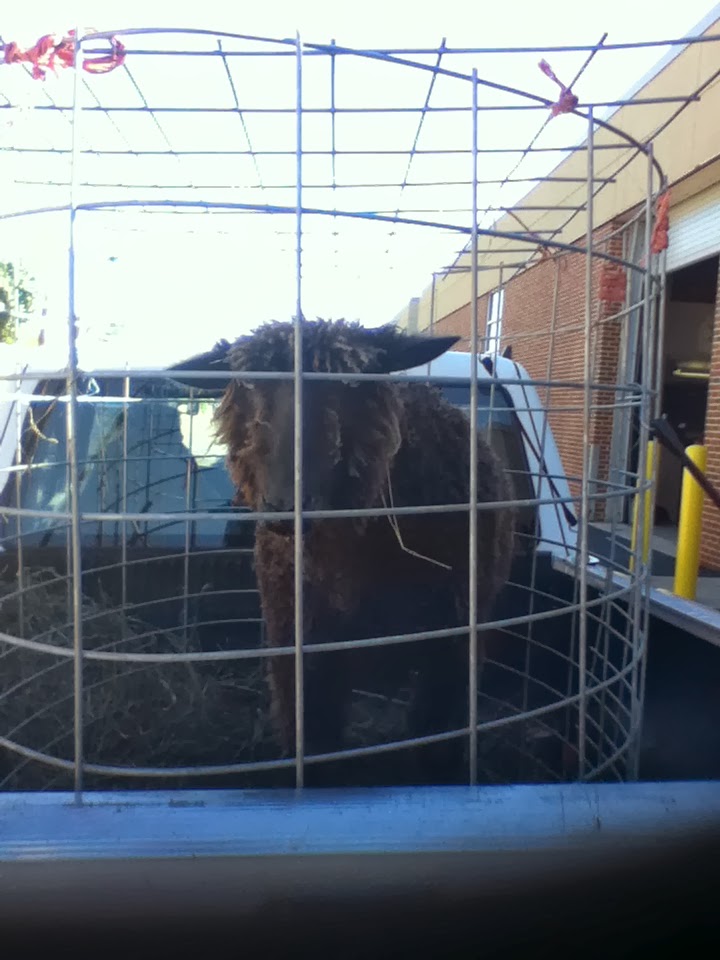
And what would a week be without wrangling some sheep and alpacas for a petting zoo at a football game?  With the help of some dedicated FFA members, CV FFA hosted a farm animal education area as part of CV THON's tailgate before the home football game.  Sadie the sheep enjoyed her change of scenery while being transported to the event!

Sadie the sheep gets to
ride in style on the way to
the 'big show.'
Some highlights of the upcoming week include training the Agricultural Issues team for National Convention, preparing students for the Stockman's Contest at the Keystone International Livestock Expo, and continuing discussions surrounding animal welfare and animal rights in CASE Animal Science.  Several lively and thought-provoking discussions have taken place thus far and each day, students become more and more engaged in this unit that is focused on developing questioning skills and understanding personal opinions.


To follow more adventures of the Cumberland Valley Agriculture Science program and FFA chapter, please visitwww.cvschools.org/Ag and www.cvschools.org/FFA.  Follow the chapter on Twitter with the handle @CV_FFA.

Sunday, September 8, 2013

From Tomato Fields to the All-American...a Week to Remember!

Only 2 weeks into the school year, students enrolled in the Cumberland Valley Agriculture Education program can make a lengthy list of learning experiences that are opening their eyes to the world of agriculture!

Agriculture Education has
3 components that are critical
to a successful and
sustainable program.
The week began with students enrolled in Introduction to Agriculture, Food, and Natural Resources (AFNR) enjoying a presentation from several CV FFA Officers about the endless opportunities available to them as FFA members.  As a student enrolled in an agriculture class, they are automatically members of the CV FFA chapter and all were encouraged to seek more information about chapter events such as YOLO, A-Day, and the Hunger Banquet.  On Wednesday & Thursday, the Intro to AFNR set up their first SAE (Supervised Agriculture Experience).  To gain skills and knowledge of record-keeping, each student will keep accurate records of their classroom learning and any agriculture activities completed outside the classroom.  Students will also be encouraged to establish an SAE outside of school to complement their career interests.  For more about SAEs, please visit this website.

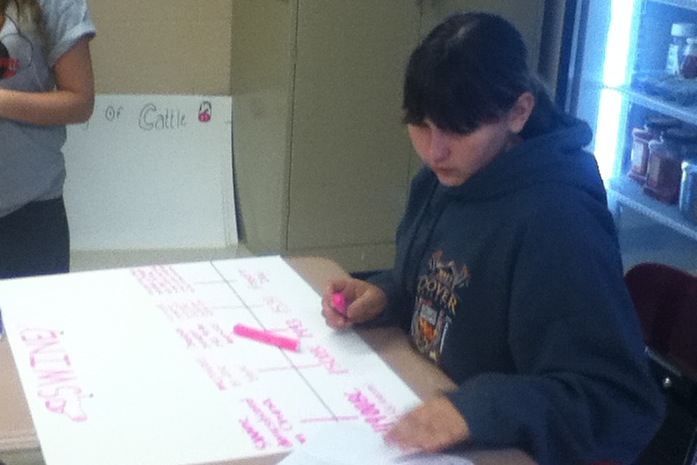
A student working on creating a timeline.
Meanwhile, students enrolled in Animal Science started to learn concepts about animal domestication and how the uses of animals has changed over the past 5,000 years.  Students worked in groups of 3 to create a timeline project that was shared with other members of the class.  Animals researched included cattle, swine, dogs, cats, sheep, horses, and goats.  Students utilized their creativity to construct a timeline and associated 'fun facts' about their specie.
One group with their finished timeline
about sheep!

Friday proved to be quite a busy day, but ran smoothly due to enthusiastic students that worked hard to accomplish several endeavors.  Students in Introduction to AFNR got a chance to learn about the Hunger Garden at CV while harvesting over 1,000 tomatoes in a friendly competition.

Students were excited to take part in this project and are looking forward to more ways to get involved next spring!  

Students hard at work scouting ripe
tomatoes in the CV Hunger Garden.
Directly after school, 5 students traveled to the All-American Dairy Show to set up photo displays for the world-class cattle that will be competing in Harrisburg this week.  After setting up the floral displays with over 125 chrysanthemums and checking for final details, the group returned to CV for the first home football game of the year. The infamous "Farm Show Milkshakes" were being sold at the game as a fundraiser for the CV FFA chapter.  With a slow start, the demand for these popular items quickly escalated and over 900 milkshakes were sold before running out of materials!

One of 4 photo displays at the
All-American Dairy Show.

Although it was quite a busy week, the excitement and learning will continue next week as 8 students will compete at the All-American Dairy Show in the Dairy Judging Forum and the Dairy Management Contest. Students enrolled in "Growing our Agricultural Leaders (GOAL)" will investigate how a Golden Buddha and a Thermometer relate to their leadership development while Intro to AFNR will learn about numerous CDEs (Career Development Event) available through the National FFA Organization.  Animal Science students can look forward to an edible activity that introduces them to taxonomy and students enrolled in the SAE course will begin to reflect on how to improve their SAE through a tuning protocol.

Great things are happening at CV Agricultural Sciences! Stay tuned for more updates!

~D

 To follow more adventures of the Cumberland Valley Agriculture Science program and FFA chapter, please visitwww.cvschools.org/Ag and www.cvschools.org/FFA.  Follow the chapter on Twitter with the handle @CV_FFA. 


Monday, September 2, 2013

Week 1--What a Whirlwind!

I’ve always heard the saying, “Time flies when you are having fun,” but the first week of the school year truly was over before it began.  After preparing my classroom, planning, and anxiously (and excitedly waiting), the first day of school finally arrived.  It was an excellent week to begin a new year of Agriculture Education at Cumberland Valley!

Rather than ‘taking it easy’ during the first week, I wanted to welcome students into an active classroom where learning happens through hands-on interactions and student-centered activities.  Students enrolled in CASE Introduction to Agriculture, Food, and Natural Resources (AFNR) began investigations into the origins of agriculture and how this vast industry affects every person every day.  The week began with an active ‘trading game’ where students were randomly assigned food, shelter, and clothing items that could be traded with other groups in order for their group to ‘survive.’ Bringing things closer to home, students later worked in pairs to research common commodities grown across the United States.

Meanwhile, their peers in Growing our Agriculture Leaders (GOAL) began to analyze their style of leadership, the 4 stages of personal development, and the 4 steps to developing as an aspiring agriculture leader.  Students reflected upon their strengths, areas of improvement, and goals as an individual.  This is only the beginning of a reflective path that these young leaders will embark on throughout the year as they experience challenges, successes, and obstacles while leading their peers.

As the week came to a close, the process of planning, revising, and reflecting continued on my part as an instructor & FFA advisor.  Major goals for next week’s classes include introducing nearly 50 students to the online AET (Agriculture Experience Tracker) system so they can track their agricultural experiences and hosting practice sessions to prepare for the Junior Dairy Management Contest & Dairy Judging Forum at the All-American Dairy Show in Harrisburg, PA.  It promises to be another exciting week in the Agriculture Department!

To follow more adventures of the Cumberland Valley Agriculture Science program and FFA chapter, please visit www.cvschools.org/Ag and www.cvschools.org/FFA.  Follow the chapter on Twitter with the handle @CV_FFA. 

Thursday, August 8, 2013

Prepping for Year 1

It's official! With a signed contract, teaching schedule, and a snazzy staff ID, I'm ready to embark on my agriculture teaching career in a 2-teacher department at Cumberland Valley High School in Mechanicsburg, PA.  After a stressful summer filled with interviews, rejections, and some professional development conferences, I am breathing much easier knowing that I am very fortunate to have secured a teaching position in Pennsylvania.

And now the work (and fun) begins! Here's a quick glance at the courses I'll be teaching this fall:

Ag Leadership
CASE Intro to Agriculture, Food, and Natural Resources (2 sections)
CASE Animal Science (2 sections)
Agriculture Experience (SAE)

I'm very thankful to have gone through a CASE institute this summer as it will allow my first year teaching to run smoothly and have a great chunk of lesson planning completed.

My goals for Year 1 of teaching:

  • Survive & Thrive!
  • Deliver engaging, relevant, and progressive lessons in each course to prepare students for future employment or post-secondary education
  • Become familiar with CV Ag Science traditions, stakeholders, and student needs
  • Train 1 CDE team to compete at State Level
  • Successfully implement AET record-keeping with 2 Freshman sections of AFNR 

I am very thankful for the support that I've received so far from my co-teacher, CV administration, and the other Agriculture teachers in Cumberland County.  I'm blessed to have the help and support of these individuals and can't wait to begin my journey to make a difference!

~D

Tuesday, July 2, 2013

Wrapping up the CASE!

It's hard to imagine how quickly my first CASE institute has gone and how much can be accomplished in such a short time.  However, in Agriculture Education, anything is possible.


Working with my partner, Neil, to analyze a water sample
utilizing a Labquest and various measuring instruments
such as pH, dissolved oxygen, and turbidity sensors.
Looking back at the photos from each day, I can recall the collaboration, teamwork, and camaraderie that developed between 21 Agriculture Educators from 7 states and I look forward to how the CASE curriculum will transform the learning environment in my future classroom.  I watched as my colleagues and I would become students and question the "How, Why, and What" of each activity, project, and problem.  This reassured me that the students will be equally engaged and will hopefully become an active learner that develops the ability to inquire, ask questions, and solve problems.  Sounds a lot like 21st-century skills right?  As our lead teachers, Matt Eddy and Lindsay Davie, kept repeating all week, "CASE answers that."

Practicing the proper technique to measure mass on a
digital scale during the first few days of the CASE institute.
This curriculum invigorates the traditional learning environment and turns responsibility over to the students who apply Science, Technology, Engineering, and Mathematical (STEM) principles to current agricultural issues.  Who has an answer for world hunger?  At the conclusion of the CASE Agriculture, Food, and Natural Resources course, students will have gained a foundation in knowledge and be prepared to give their solution to world hunger.  The sky's the limit after experiencing this course!

Successful completion
of "Build-a-Bloom!"
I was able to attend this CASE institute through the generosity of Impact FFA, a group that sponsored a scholarship for a female, pre-service teacher that was a member of NAAE (National Association of Agriculture Educators).  I feel humbled to have been awarded a scholarship of this magnitude so early in my teaching career and encourage this organization to continue supporting future female pre-service teachers in the future.  To learn more about the ripple-effect created by Impact FFA, please visit www.ffa.org/impactffa.  

Although my first CASE institute is in the books, I have begun to reflect on how this experience will help me rethink classroom instruction to benefit students in developing their critical-thinking skills and being prepared to tackle the most important challenges in the future.  As I've been told, everyday is a learning experience and I look forward to what is coming around the corner next!

~DJR

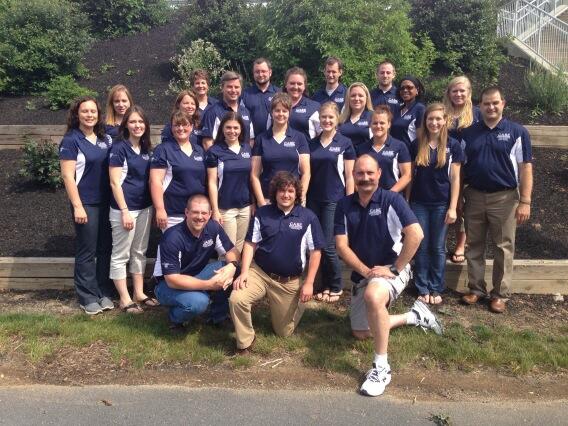
The #PSUCASE13 crew!

 It was such a pleasure getting to know Agriculture Educators from across the country during this institute!  Whether it was enjoying a fantastic meal along the Susquehanna River or talking about their agriculture program, it was a great bunch of individuals to work with throughout the 10-day experience.

A huge "Thank You" to our lead teachers, Lindsay Davie and Matt Eddy, for sharing your experience with the CASE curriculum and giving us tricks and hints to help improve our implementation of CASE.


Finally, "Thank You" to Cumberland Valley H.S. & Penn State University for hosting this institute.  It was excellent to learn the curriculum in a school that has adopted the CASE curriculum and experience it in a 'real' learning environment.